Thanks to Mao, Zhang Yin's a billionaire: The revolutionary leader transformed women's lives, but China still has a long way to go
Will Hutton
Sunday October 15, 2006
The Observer
It was one of China's proverbs that Mao loved to quote; women, he would say, hold up half the sky. But until the communist revolution of 1949 the Chinese had not meant it. The Chinese imperial system, famously, had been one of the most anti-feminist societies on Earth. Women had no rights, existing only to have babies and please men, the richer forced to hobble and disfigure themselves by binding their feet from birth to affirm their essential purpose - decorative daintiness.
But last week it was reported that China's richest billionaire is now a woman - 49-year-old Zhang Yin is worth a cool $3.4bn (£1.8bn). The tycoon is the world's richest self-made woman, having built China's largest paper recycling business, Nine Dragons Paper, which was floated on the Hong Kong stock market just six months ago. She seems an eloquent symbol of the new China; a capitalist whose success and wealth was unthinkable before Deng Xiaoping freed China from the embrace of Maoism in 1978. It is capitalists such as her who are proof that paradoxically it is communist China that is home to the globe's most vigorous capitalism. And she is a woman.
In China, though, beware. Nothing is quite what it seems. Zhang Yin owes her success both to pro-market Deng Xiaoping and ardent communist Mao. As the eldest daughter of a family with eight children, her expectation before the communist revolution would have been to grow up illiterate before becoming her husband's chattel. Mao's radical egalitarianism may have given China the murderous mayhem of the Cultural Revolution. But he also transformed the role, expectations and education of women.
In 1949 female illiteracy in rural China was 99 per cent. In 1976 when Mao died it was 45 per cent and today it is 13 per cent. One of Mao's first acts was to give women the same rights in divorce as men, and for all his other barbarism he consistently championed the equality of women.
China is still a sexist society, but compared with the rest of Asia it is light years ahead. Female illiteracy in rural India, for example, is still 55 per cent. The change has gone deep into the marrow of Chinese society. One survey recently revealed that Chinese girls between 16 and 19 name becoming president, chief executive or senior manager of a company as their top career choices; Japanese girls between 16 and 19 say they want to become housewives, flight attendants or child-care workers. One of China's most formidable economic and social resources has become its women.
As the daughter of an officer in the People's Liberation Army, Zhang Yin also understands the corrupt and controlling pathology of Chinese communism well - and has understood the imperative to keep ownership and direction of her company as distant as possible from Beijing. In China the party controls, or has the capacity to control, everything; the number of companies forced into decline or even bankruptcy because they were compelled to support party aims - bailing out an endemically loss-making company to protect jobs or buying a state-owned company at an astronomic price to feather the nest of a senior official - is beyond counting. Indigenous Chinese capitalism is a form of hit-and-run guerrilla economic warfare in a constant battle with the world's greediest and most corrupt officialdom. Survival depends upon paying tribute. It is no accident that two thirds of China's six million private businesses are owned and run by ex-communist officials. Almost every private businessperson in China is either a party member or applying to join.
Zhang has avoided much of that - courtesy of Hong Kong, a Taiwanese husband and managing to get out of China in the months after Tiananmen Square when repression was at its height and the prospects for any kind of private enterprise seemed nil. Her cleverest moves were her first; incorporating her company in Hong Kong in 1985 and then marrying a Taiwanese with a non Chinese passport. In exile in Los Angeles in 1990 the pair founded America Chung Nam - a company specialising in scrap paper brokerage as she had been doing in Hong Kong.
Scrap paper is one of the few industries the party considers non-strategic and which it indulges - another smart choice for an ambitious woman. In December 1991 the Soviet Union collapsed, and in January 1992 the ageing Deng Xiaoping declared in a tour of Guangdong, China's most pro-capitalist province, that as international communism was dead the only way for Chinese communism to survive was to embrace pro-market reform. In particular it should welcome inward investment from foreign companies with know-how and technology. It was glorious, he said, to be rich.
There was an avalanche of inward investment, including America Chung Nam building a paper and board mill in the very same Guangdong- a foreign investor even if owned by a Chinese living abroad. After all, China's booming exports would need to be wrapped in paper and paperboard. Guangdong's exports have grown phenomenally; so have sales of paper and board.
And six months ago Zhang Yin and her husband cashed in - floating their shares not in one of China's stock markets on the mainland, but in Hong Kong. Here a private company can keep its distance from the party; if there is a dispute with the communists it gets settled in Hong Kong's still independent legal system - legacy of the British - and not in one of the mainland's rigged courts.
The extent of China's reform, and its subsequent growth, is stunning. It is also true that Ms Zhang could not have made her money if China had not opened to the world. But nobody should believe that somehow her fortune means that China has made the full transition to capitalism. Rather she has exploited the system's fault lines. This remains a one-party state, in which every institution - from the media to its companies - is constructed to sustain its monopoly of power.
Entrepreneurs such as Zhang Yin only succeed if they find ways around the system; they can only push the economy so far. One day the party will have to let go properly. The issues are only how and when.
http://observer.guardian.co.uk/comment/story/0,,1922797,00.html
Saturday, September 15, 2007


News Article: Ratan Tata
INTERVIEW WITH INDIAN INDUSTRY MOGUL RATAN TATA
"We Indians Have to Struggle to Catch Up"
When Ratan Tata took over the helm from his uncle 16 years ago, the conglomerate resembled an opaque jungle of companies. He rebuilt, tore down, expanded and forged a powerful holding company out of the general merchandise store with its approximately 300 individual companies. That holding company today functions primarily in seven areas, including steel, automobile production, information technology, telecommunications and energy.
Anyone who travels through India encounters the name everywhere they turn. Tata -- it is the TelekomSiemensSAPVolkswagenThyssenKrupps of India. The business volume grew from $4 billion annually in 1991 to more than $22 billion today. Additionally, about two thirds of Tata holding company shares have been placed in non-profit foundations. In fact, Ratan Tata leads the business in keeping with his family's values: modest, community oriented, extremely reclusive.
At the beginning of April, Tata finally completed its $11.3 billion (€8.45 billion) takeover of British-Dutch steel giant Corus, a deal which had been in the works since last autumn. The move instantly catapulted the company to fifth place in the internationally booming steel business -- and Chief Executive Tata into the limelight of public interest. Recently there was a rumor that he was planning to spend additional billions to snap up a large portion of Deutsche Telekom's IT business unit, T-Systems.
SPIEGEL: Mr. Tata, the purchase of Corus is the largest ever takeover of a foreign firm by an Indian company. Was this just a business deal, or -- as many observers have suggested -- a symbol of India's growing influence?
Tata: It is primarily a strategic acquisition. Corus offers us a good springboard for entry into the European market. It enables us to achieve a global scale. And most important: Corus employees are similar to ours and used to producing our kind of top quality products. All things considered, it was a very good expansion of our steel business. And even if I don't see the deal symbolically -- maybe it shows that an Indian company now not only wants to play an important role in India, but also seeks to be a global player.
SPIEGEL: It turned out to be an expensive move. Was Corus worth that much?
Tata: Those who accuse us of having paid too much are passing judgement too quickly. Of course in the end we paid more than we wanted to. But neither we nor our negotiating partners at Corus drove the price up. Rather, hedge funds got involved and our Brazilian competition suddenly entered the bidding. But I did not see any alternative to Corus. And I still believe that we can benefit from the many synergies that exist.
…
SPIEGEL: ... who ask: What happens to Tata if the demand for steel collapses and worldwide prices again take a dive?
Tata: It is our responsibility to ensure that something like that does not happen in the first place. You know, a few years ago in India the automobile market collapsed. At the time, we didn't lose any of our market share, but that part of our business shrank by about 40 percent. We were unable to shut down any factories or to lay anyone off. We just sat there and bled. It was the most frustrating period in my whole life. And while we were restructuring, we also needed money, but hardly anyone was interested in Tata shares. Even our holding company had to jump in. Today a share is worth more than 13 times as much -- an argument that I hope will also convince the skeptics in the steel business.
SPIEGEL: For the very first time, Indian companies last year spent more on acquisitions abroad than foreign companies invested in India. It seems that India, despite a population of over 1 billion, is becoming too small for its own companies.
Tata: Actually, we have invested more within India than abroad. But there is indeed a perception that the opposite is true. Many of our domestic projects are unfortunately sitting around waiting for political approval. And I ask you: How much time would it take in India before we would be given the green light to take over a company as large as Corus?
SPIEGEL: Tata isn't just involved in the steel business. It still controls a conglomerate of about 100 unique enterprises. How does all that fit with the internationally dominant management philosophy of concentrating on a core business?
Tata: In the early 1990s we slimmed down significantly and now we only have seven, clearly defined business segments. Within each segment, operations can be streamlined. And we have done that. But ultimately these are really very unique segments. I cannot see how our chemical sector could meld with our auto sector.
…
SPIEGEL: Already, one third of Tata's turnover comes from abroad. What is still Indian about your company?
Tata: Actually, we have always looked very much within. Moving to export some of our products was our only expansion. It was only two or three years ago that we began realizing that we could no longer remain dependent on a single market -- that we could grow abroad through investment and acquisition, particularly in those countries where we could operate similarly to the way we do in India. It would be great were we considered abroad as a globally operating company with a local touch -- that just happens to be owned by a group of Indians.
SPIEGEL: So you really would like Tata to be seen as an "Indian" company?
Tata: Not in the ethnic sense. I would prefer if we were seen as a part of the global community. Coca-Cola is sometimes seen as being too much of an American company. I prefer the way Shell is perceived. It, too, is an international brand, but you really have to take a close look to realize that Shell is a British-Dutch firm.
…
SPIEGEL: Most Tata shares are held today by foundations dedicated to improving the quality of life in India. Is your family's humanitarian philosophy something unique or do Indian companies generally have a greater sense of social justice than their Western counterparts?
Tata: It is neither typical for Indian firms nor for international companies. But there are comparable companies both in India and in the West that invest a part of their profits in charities. But in a country like India, the money is less likely to flow into art exhibits than into poverty relief projects.
SPIEGEL: Is India's economy experiencing a new era of self-confidence or is it already tending toward overconfidence?
Tata: I am pleased with the newfound confidence. But it should not be based on unrealistic dreams. We live in a highly competitive world -- and we Indians have to struggle to catch up. So modesty is necessary, even if there is also a need for a certain amount of national pride. When it comes down to it, we have managed our country's economy poorly for long enough. There is really no reason to now think that we can conquer the world.
SPIEGEL: Do you see a risk of megalomania in India?
Tata: I don't think it will ever get that far, but there is always the possibility. In the end, it depends on the people in charge.
SPIEGEL: Of course it's not just individual managers who could overestimate themselves. India's economy also could overheat.
Tata: I think our current growth rates are steady. We are concerned that the economy could overheat quickly. A massive increase in consumption could lead to inflation, which would not be good at all for our country. But India has never seen as much investment as today -- even if it is less than in China.
SPIEGEL: What do you see as the strengths and weaknesses of your country when compared to China's booming economy?
Tata: The political system of the People's Republic of China can make things easy. Decisions are made quickly and results come quickly, too. In our democracy, on the other hand, such things are extremely difficult. We like to say that India has the advantage of being a large market. We have provinces, we have the rule of law, we have a system of justice. But those are also weaknesses when compared with China. On the other hand, one of our strengths is that we are very individualistic, and as individuals we are very creative. But that, too, is a weakness, because it keeps us from working well together. Everyone thinks only about his own profit. India has probably lost its position to China as the world's workshop. At the same time it has the power to be ahead of China when it comes to knowledge. Not that the Chinese are far behind. They will get there. But our challenge is to invest sufficiently in education.
…
SPIEGEL: What is real luxury for a wealthy businessman like yourself?
Tata: Time. I would say having time for a private life is my biggest luxury. In the little time I have for myself, I have so many interests. I love to read, I love to design. If I ever retire, I want to create a small design group where I can simply develop products for fun, not because they have to become profitable. I enjoy thinking about impossible things, and how I can perhaps actually make them possible.
Interview conducted by Padma Rao and Thomas Tuma
Source: http://www.spiegel.de/international/business/0,1518,476262,00.html
Saturday, September 8, 2007
Link to map on FileFront
http://hosted.filefront.com/lindacliu/
James, you will probably find that there are multiple players in the game if you open the game directly, please open it in UT2004, then play map from there. Also, there seems to be a problem with the the continuous sky as it does not appear when in game mode. Thanks.
James, you will probably find that there are multiple players in the game if you open the game directly, please open it in UT2004, then play map from there. Also, there seems to be a problem with the the continuous sky as it does not appear when in game mode. Thanks.
Final Map
_Narrative.&.Engagement.with.the.Client's.Ideas_
In experiment 2 I have used the quotes from Hawking and Darwin as a starting point to develop ‘laboratories’ in front of and behind a vertical surface respectively.
In front of the vertical surface: Stephen Hawking
"The whole history of science has been the gradual realization that events do not happen in an arbitrary manner, but that they reflect a certain underlying order, which may or may not be divinely inspired."
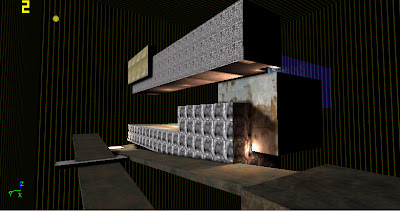
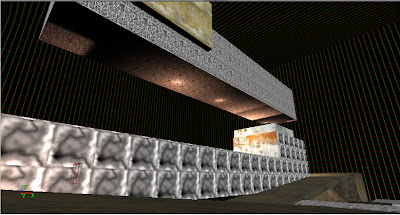
 Hawking’s laboratory in front of the vertical surface is composed of intersecting rectangles, where the space is defined by a large subtraction from the main rectangle. The aim was to envisage the rectangles as distinctive elements and independent spaces that have been morphed together to form the ultimate form that exhibits the unique qualities of each element. This idea was directly inspired by the notion that events are not arbitrary coincidences, but happenings which follow an underlying order - although the logic may not be immediately evident. The laboratory engages with the idea of attributing an innate logic to events, and in this case, spaces. The rectangles are intersected to form a ‘jigsaw’, and when deciphered, reveals that they are in fact in ratio with each other. I have envisioned the purpose of such morphing of spaces, is to attain something new and perhaps experimental. Maintaining a cohesive range of colours and textures on the main body of the laboratory, I inserted a transparent rectangle that almost disappears into the air to break up the regularity and add a sense of ‘arbitrariness’ – though the whole space is very much a methodically arranged space.
Mediating space: the ramp and tunnel: Quotes after undergoing ‘Electroliquid Aggregation’
If the underlying order of events is arbitrary, and thus not subject to logic, then fools’ experiments are the only way to decipher the multitude of possibilities and random coincidences.
 The ramps leading around the outside space are based upon the word ‘arbitrary’ which give the immediate connotation of being based on personal randomness and whim, rather than reason and logic. However useless the multiple ramps may be, it is effectively a mediating element between the confusing and ambiguous laboratory inside, and the scarily logic space outside – thus the notion from the electro-liquid aggregated idea that random playfulness may lead to unexpected discoveries. The ramps and blocks lead to a long tunnel that forms a U-shape around and ultimately leading to Darwin’s laboratory. The tunnel is massive and seemingly continuous, though the otherwise laborious trek is accented with sloping ceilings, obstacles and overhanging blocks.
Behind the vertical space: Charles Darwin
"I love fools' experiments. I am always making them."

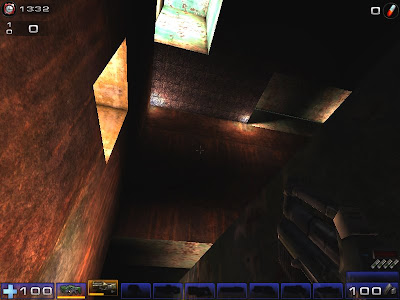
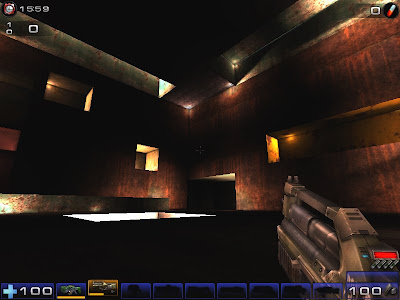
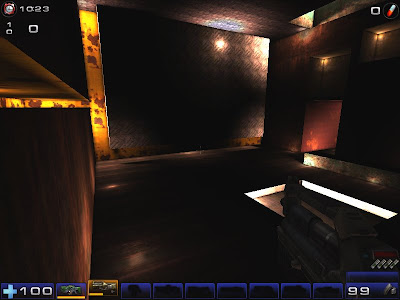
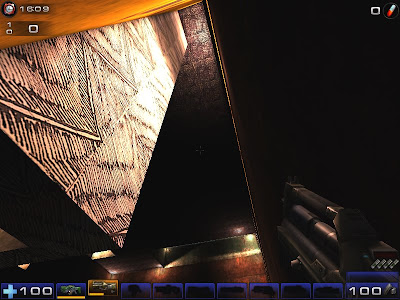
 Upon entering Darwin’s laboratory, one is overwhelmed by the vastness of the space and the multitude of lights scattered around. Essentially the space is made up of smaller and irregular rectangles added to and subtracted from the main rectangle. There are ceiling vaults, holes and slits in the walls, and protruding and recessed blocks on the ground, whose shape and size are enhanced by orange lights of different brightness. The overall impression is one of randomness, but one very much linked to playfulness and active interaction with the spaces. Darwin can literally hide in the cut out spaces and under blocks to find an alternative viewpoint of his surroundings. The space encourages foolish and experimental ways of using and seeing it – thus it becomes a metaphor for coincidental discoveries.
In experiment 2 I have used the quotes from Hawking and Darwin as a starting point to develop ‘laboratories’ in front of and behind a vertical surface respectively.
In front of the vertical surface: Stephen Hawking
"The whole history of science has been the gradual realization that events do not happen in an arbitrary manner, but that they reflect a certain underlying order, which may or may not be divinely inspired."


 Hawking’s laboratory in front of the vertical surface is composed of intersecting rectangles, where the space is defined by a large subtraction from the main rectangle. The aim was to envisage the rectangles as distinctive elements and independent spaces that have been morphed together to form the ultimate form that exhibits the unique qualities of each element. This idea was directly inspired by the notion that events are not arbitrary coincidences, but happenings which follow an underlying order - although the logic may not be immediately evident. The laboratory engages with the idea of attributing an innate logic to events, and in this case, spaces. The rectangles are intersected to form a ‘jigsaw’, and when deciphered, reveals that they are in fact in ratio with each other. I have envisioned the purpose of such morphing of spaces, is to attain something new and perhaps experimental. Maintaining a cohesive range of colours and textures on the main body of the laboratory, I inserted a transparent rectangle that almost disappears into the air to break up the regularity and add a sense of ‘arbitrariness’ – though the whole space is very much a methodically arranged space.
Mediating space: the ramp and tunnel: Quotes after undergoing ‘Electroliquid Aggregation’
If the underlying order of events is arbitrary, and thus not subject to logic, then fools’ experiments are the only way to decipher the multitude of possibilities and random coincidences.
 The ramps leading around the outside space are based upon the word ‘arbitrary’ which give the immediate connotation of being based on personal randomness and whim, rather than reason and logic. However useless the multiple ramps may be, it is effectively a mediating element between the confusing and ambiguous laboratory inside, and the scarily logic space outside – thus the notion from the electro-liquid aggregated idea that random playfulness may lead to unexpected discoveries. The ramps and blocks lead to a long tunnel that forms a U-shape around and ultimately leading to Darwin’s laboratory. The tunnel is massive and seemingly continuous, though the otherwise laborious trek is accented with sloping ceilings, obstacles and overhanging blocks.
Behind the vertical space: Charles Darwin
"I love fools' experiments. I am always making them."


 Upon entering Darwin’s laboratory, one is overwhelmed by the vastness of the space and the multitude of lights scattered around. Essentially the space is made up of smaller and irregular rectangles added to and subtracted from the main rectangle. There are ceiling vaults, holes and slits in the walls, and protruding and recessed blocks on the ground, whose shape and size are enhanced by orange lights of different brightness. The overall impression is one of randomness, but one very much linked to playfulness and active interaction with the spaces. Darwin can literally hide in the cut out spaces and under blocks to find an alternative viewpoint of his surroundings. The space encourages foolish and experimental ways of using and seeing it – thus it becomes a metaphor for coincidental discoveries.
Tuesday, September 4, 2007


Subscribe to:
Posts (Atom)